

An 800 mm deep desk is the standard choice, and for most screen work it’s the right depth. It holds a screen, a keyboard and some paperwork, with the screen far enough away to read comfortably.
Go down to 600 mm for a laptop or a small screen in a tight room. Go deeper only when you need room for large drawings, big screens or a visitor across the desk. Here’s how to choose.
Quick answer: a standard office desk is 800 mm deep, the usual minimum in the European desk standard. A 600 mm deep desk suits a laptop or a small screen in a small room. Crescent corner desks are 1200 mm deep overall, and back-to-back bench desks are about 1600 mm deep for two people.
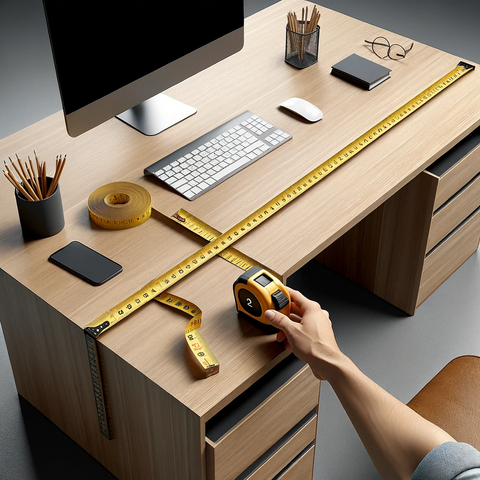
Standard office desk depth: 800 mm, or 600 mm for small spaces
Desk depth is the distance from the front edge, where you sit, to the back edge. Width is the measurement from side to side. So an 800 mm deep desk is 80 cm from front to back, and a 600 mm one is 60 cm. On a corner or crescent desk, check the depth of each arm as well as the overall size.
Our standard desk ranges come in two depths: 800 mm and 600 mm. Widths vary more, from 800 mm to 1800 mm in both depths.
The European standard for office desks, BS EN 527-1, sets 800 mm as the usual minimum worktop depth for an office workstation. For fixed-height desks, it accepts 600 mm in some situations, for example with flat screens of 17 inches or smaller. That’s on condition that the desk isn’t against a wall and two people don’t sit facing each other across it.
| Depth | Type of desk | Best for |
|---|---|---|
| 600 mm | Narrow desk | A laptop or one small screen, in a small room |
| 800 mm | Standard desk | Everyday screen work with a keyboard and papers |
| 880 to 1000 mm | Large desk | Big screens, drawings, or a desk that doubles as a meeting space |
| 1200 mm | Crescent corner desk (overall depth) | Two screens and paperwork side by side |
| 1600 mm | Back-to-back bench desk | Two people facing each other on one frame |

How deep should a desk be for a monitor?
Deep enough to set the screen about an arm’s length away. That’s HSE’s advice for screen work, along with having the top of the screen level with your eyes.
An 800 mm desk gives you room to move the screen back to that distance. On a 600 mm desk the screen may sit closer than you’d like. Check it by sitting at the desk and stretching out your arm.
A monitor arm helps on either depth. It lets you adjust the screen’s distance and height, and frees the worktop where the stand used to be.
Test your own kit before you buy
The quickest way to choose between 600 mm and 800 mm is to try both on the desk or table you have now.
- Mark the depths. Put a strip of tape 600 mm back from the front edge, and another at 800 mm.
- Lay out your real kit. Set out the screen on its stand or riser, the keyboard, the mouse, your laptop and the papers you work from, the way you’d use them together.
- Check the screen. Sit down and stretch out your arm. The screen should be about an arm’s length away, with the whole screen and its stand still within the 600 mm or 800 mm line.
- Check the typing space. The Display Screen Equipment Regulations ask for space in front of the keyboard to rest your hands and arms. HSE’s advice is to keep the mouse in line with your elbow. Type for a minute: your wrists should stay straight, not bent up, down or sideways, and your arm and the mouse should move freely without hitting other kit. On a desk that’s too shallow, they won’t.
- Check your reach. The things you use all day, such as a notepad and phone, should be within easy reach. On a deep desk, don’t let the back half become a place you have to stretch to.
If it only fits at 800 mm, that’s your answer. If it fits at 600 mm with room to spare, the narrow desk will do.
When a deep desk makes sense
Choose a deeper desk when 800 mm runs out. These are the usual reasons:
- Two or more screens. These need width more than depth, so check the width first. A crescent corner desk curves round you, giving a long run of worktop. Ours measure 1600 or 1800 mm by 1200 mm.
- Large drawings or plans. Architects’ plans, graphic design work with screens and prints, or finance work with several screens and printed reports all spread out. Some of our large desks are 880 mm or 1000 mm deep, with widths up to 2200 mm.
- Crafts and creative work. A sewing machine, a tabletop easel or a box of art supplies needs its own space beside the computer. Add them to your kit test before you choose.
- Meetings at the desk. A deeper desk can give a visitor more room across from you, depending on where the screen sits.
Browse large office desks and corner and crescent desks.
When a narrow desk is the better choice
A 600 mm deep desk is the better choice when the floor is tight. It gives 200 mm back to the room compared with a standard desk, which adds up across a row.
It works best if you use a laptop, or one small screen. It also suits a minimalist set-up, as long as your kit test shows there’s enough room to work. It works less well with two large screens and a pile of paperwork. The desk standard’s conditions for 600 mm are worth following: keep it away from the wall, and don’t seat two people facing each other across it. See our narrow desks, which come in widths from 800 mm, and for a small room at home, our home office desks.
Leave legroom as well as worktop
Depth isn’t only about the top. You need space under the desk to move your legs, which HSE’s screen work guidance lists as part of a good set-up.
An under-desk pedestal takes some of that space. If legroom is tight, a desk-high pedestal standing beside the desk keeps the drawers out from underneath. Ours come in 800 mm and 600 mm depths, to line up with the desk.
Measure the room, not just the desk
A deeper desk takes floor from the space behind it. You still need room for the chair to push back and for people to walk past.
Mark the desk’s outline on the floor with tape before you order. Then sit where the chair will go, push back as if to stand up, and check that pedestal drawers and any cupboard nearby can open fully.
If a deeper desk won’t fit, move things off the worktop instead, so the depth you have is free for the screen and keyboard:
- Up on the wall. A shelf or wall-mounted storage unit above the desk takes books, files, supplies and decorative things. Hang artwork on the wall rather than standing it on the desk.
- In a drawer. Give pens, notebooks and sticky notes one drawer, and give each kind of document and supply its own place, so they’re easy to find.
- In a filing cabinet. Papers you don’t need every day don’t belong on the worktop.
- In one organiser. A small desktop organiser, sized to the space you have, holds paperclips, stationery and small gadgets. Some have a slot for your phone.
- Under the desk. Cable clips and a cable tray keep leads tidy and off the worktop.
See our office storage solutions.
Our guide to how much space to leave between desks shows how to measure that. If you need more worktop without a deeper desk, see our desk extension ideas.
Then choose the look
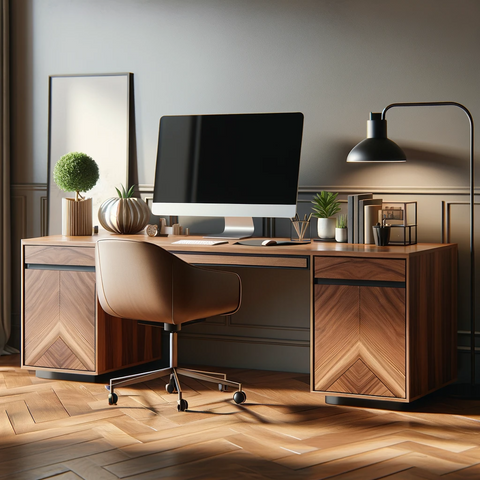
Once you know the depth that works, pick a style that suits the room. A sleek, modern desk and a traditional one can be the same depth. A desk that suits the room’s size and style will look right as well as work.
The short answer: start at 800 mm
For most people, 800 mm is the right desk depth. Drop to 600 mm when space is tight, and go deeper only for a clear reason, such as large drawings or big screens.
Still not sure? Tell us how you work and how big the room is, and our friendly team will suggest a size. Or browse all our office desks.


