

The traditional office, with its grid of desks and stern boardrooms, has been changing for years. So what does the future of office design hold for UK workplaces? New technology and new ways of working are pushing it in some fascinating directions. Here are our educated predictions, alongside a few imaginative, ‘out there’ ones.
We’ve split them in two. First, what to plan for in the next five years. Then the ideas that are ten years or more away, if they arrive at all.
The future office environment: what’s already changing
Some of the office transformation is already under way. These changes started before the predictions below, and they’re shaping what offices buy and build today.
So what will UK offices look like in five years? Plan around three things: hybrid attendance, spaces for both conversation and concentration, and layouts you can rearrange.
Start with your own facts. Ask staff which tasks bring them into the office. Check how many people come in on your busiest days. Use both to decide how many shared desks and meeting spaces you need. Keep allocated desks for anyone whose needs call for one.
Home and hybrid working
Working from home became normal for many office staff during the pandemic, and many businesses have kept it in some form. For a lot of people, the office of the future is a spare bedroom or a garden office for part of the week.
It’s now a settled pattern for many. The Office for National Statistics (ONS) found that “more than a quarter (28%) of working adults in Great Britain hybrid worked between January and March 2025” (ONS, June 2025).
That makes the home desk as important as the office one. Our home office furniture range gives people the same options they’d have at work. Our guide to hybrid working covers how to set up the office around it.
At home, start with the basics: a suitable desk and an adjustable chair. A kitchen chair might do for an afternoon. It won’t do for three days a week.
Hybrid working can also cut premises costs, if a business needs less space or uses less energy. Keep the same office open at the same size, though, and most of those costs stay.
Fewer people in on any one day often means fewer fixed desks. Desk sharing works best with a simple booking system. Every shared desk should be ready to use, with power, a screen connection and a chair that adjusts.
More social spaces
When staff come in to meet and work together, the office has to suit that. Expect fewer rows of identical desks and more breakout areas, shared tables and booths where people can talk face to face.
A good social space mixes a few settings:
- Shared tables for working side by side or eating lunch together.
- Comfortable seating, such as sofas and armchairs from our breakout seating range, for informal chats.
- A refreshment point, so people have a reason to gather.
- Quieter settings nearby for focused work.
Keep calls and video meetings away from concentration areas. A booth or a small room stops one person’s call becoming everyone’s distraction.
Choose movable tables, modular seating and dividers, so the layout can change as your team does. Provide power and reliable wi-fi wherever people open a laptop. Offer a choice of lighting and seating too. People differ in how much light, noise and company they like while they work.
Ask staff before you redesign. They know which spaces get used and which sit empty.
There’s a wellbeing reason for social space, too. The NHS says “good relationships are important for your mental wellbeing” (NHS, 5 steps to mental wellbeing). A shared lunch space gives colleagues a chance to connect. Keep it optional, and keep somewhere quiet for people who need it.
Outdoor space
Many people got used to meeting outdoors during lockdown, and some offices now make room for it. Computers and the British weather don’t mix, but a covered terrace or garden seating gives staff somewhere to eat lunch or hold an informal meeting.
More natural light
Future offices may make more of daylight, through larger windows and skylights.
Which one suits you depends on the building. Skylights suit rooms directly below a roof. Larger windows can bring daylight to lower floors, where the building allows it.
More daylight can also mean more glare. HSE’s Lighting at work guidance says poor lighting can cause symptoms such as eye strain and headaches. It also warns that flicker can trigger seizures in some people with epilepsy. Check blinds, screen positions and task lighting whenever you move desks around.
One myth to drop: daylight through a window won’t help your body make vitamin D. NHS guidance explains that the UVB rays your body needs “can’t get through the glass” (NHS guidance on vitamin D).
Outdoors is different. The NHS says most people can make the vitamin D they need from sunlight on their skin. That applies from about late March or early April to the end of September. That’s one more point in favour of an outdoor lunch spot. Cover up or protect your skin if you’re out in the sun for long periods.
What UK workplace law already requires
Some ‘future’ features are already legal duties. In Great Britain, the Workplace (Health, Safety and Welfare) Regulations 1992 cover both light and air:
- Lighting: every workplace must have “suitable and sufficient lighting”. As far as is reasonably practicable, that should be natural light (regulation 8).
- Ventilation: every enclosed workplace must be ventilated by “a sufficient quantity of fresh or purified air” (regulation 6).
HSE’s ventilation guidance explains what this means in practice. Build lighting and ventilation into any redesign from the start. That matters most when you add partitions, booths or pods, which change how light and air reach each desk.
The office reimagined
New technology, new work habits and the need to go green are pushing office design into ideas that once belonged in science fiction. Here’s what the workspace of the future could look like in UK offices, including how much of it might be controlled by AI.
Most of what follows is ten years or more away, and some of it may never happen. Treat it as a look ahead, not a shopping list. Where something is useful now, we say so.

The sustainable shift
Greener offices start with what you already have. Keep furniture you can retain, repair or reconfigure. When something does need replacing, consider reused furniture, recycled materials and finishes documented as low-emission.
Lighting is the other change you can make now. Efficient LED lighting works well with controls that dim or switch off lights when there’s enough daylight or nobody’s there. The government’s Energy Technology List describes presence detectors that switch off or dim lighting “when the area is unoccupied” (Energy Technology List).
The ideas below are further off. Treat them as developments to assess for a particular building project, not things to buy this year.
Green construction materials
The drive to go green will bring more eco-friendly building materials. Expect offices built from recycled materials, carbon-absorbing concrete and even mycelium bricks, made from the root structure of fungi.
Living walls and rooftops
Moss walls and vertical gardens are just the beginning. Future offices might come alive, literally, with green terraces, self-sustaining gardens and perhaps even rooftop farms.
Energy harvesting floors
Imagine a floor that generates electricity from the footsteps of the people walking on it. Ideas like this could one day become commonplace.
Tech-driven transformation
Smart-office tools you can use now
Some smart-office technology is already ordinary. Practical options include:
- Desk and room booking, so people know there’s a space before they travel in.
- Occupancy-based controls that turn lighting and heating down in empty rooms.
- Daylight-responsive lighting that dims when the sun is doing the work.
- Hybrid meeting kit: cameras, microphones and screens, so remote colleagues can see, hear and join in.
Everyday software helps too. Office software can provide calendar reminders, while AI assistants can help draft emails for people to check before sending.
Everything from here on is emerging or imaginative. Some of it may reach offices. Some of it won’t.
AR-assisted workspaces
Augmented reality (AR) could play a big role. Picture interactive 3D models projected into a meeting, or AR glasses that let you multitask hands-free.
AI room customisation
Rooms could adjust their lighting, temperature and even scent to each person’s preferences, all controlled by AI. It’s a real possibility.
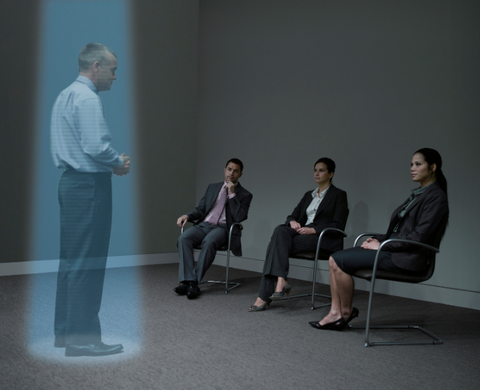
Holographic conference rooms
Forget video calls. The future may bring holographic conference rooms where remote workers appear as lifelike holograms, so virtual meetings feel "real".
Health and wellness prioritised
Biophilic design principles
Many offices already bring nature indoors with plants. Future offices may go further, with water features, more natural light, and wood and stone structures for a more organic feel.
Mental health sanctuaries
Quiet zones, meditation rooms, meeting booths and even sensory-deprivation spaces might become standard. People are more aware of mental health than ever, and offices will reflect it.
Dynamic ergonomics
Adjustable chairs and standing desks are only the start. Imagine workstations that adjust themselves through the day to suit the person using them.
Today, the practical version is simpler. For home and shared workstations, start with a suitable desk, such as one of our height adjustable desks, and an adjustable chair.
Then follow HSE’s display screen equipment guidance. It says employers must:
- Assess each workstation: the chair, screen, keyboard and surroundings.
- Plan breaks from screen work, or changes of activity.
- Provide an eye test if a worker asks for one.
HSE says the law applies to home workers and hot-deskers too. If people change desks regularly, they should do a basic check each time they sit down somewhere new.
The ‘out there’ predictions
The ideas above are grounded in current trends and technology. Now for the whimsical and wildly imaginative.
Mood-altering environments
Imagine a room that can read your emotions. Having a stressful day? The office senses it and changes the lighting and sound, and even releases a calming scent, to help you relax and refocus.
Interactive, shape-shifting furniture
Ever wished your chair could become a sofa, or your desk could grow when you need more space? The office of the future might have smart furniture that rearranges its molecules to become whatever you need. Think of it as the ultimate transformer for the workplace.
Office pets: the robotic kind

Plenty of people would love an office dog, but allergies and day-to-day care get in the way. Enter robotic pets: AI-driven companions that mimic the behaviour and warmth of real animals without the mess.
Merging work with play
Gamified office spaces
With better virtual reality (VR) and AR, everyday tasks could be turned into games, mixing work with play.
Office amusement parks
Why stop at ping pong tables and arcade machines? Future offices could host roller coasters, VR zones or even lazy rivers, for relaxation and team bonding.
How to future-proof your office space now
You can’t buy a hologram room yet. You can make sure today’s office copes with whatever comes next. Work through these steps in order:
- Measure attendance. Check typical and peak days before you decide how many desks to keep.
- Ask staff what they need. Find out which tasks bring them in, and what’s missing when they arrive.
- Plan zones. Give focused work, calls, meetings and socialising each a space of their own.
- Choose furniture you can move. Modular seating, movable tables and dividers let the layout change without a refit.
- Put power where people sit. Shared desks and breakout tables need sockets and reliable connectivity. Desk power modules are one way to add them.
- Check light and air. Look at daylight, glare and ventilation, and remember the 1992 regulations above.
- Set up home desks. Hybrid staff need a suitable desk and an adjustable chair at home as well.
Not sure what to act on? This table sorts the ideas in this post by how close they are.
| Idea | How close? | What to do |
|---|---|---|
| Hybrid working and desk sharing | Now | Plan desk numbers from attendance |
| Booths, quiet zones and social spaces | Now | Plan zones with your staff |
| Movable, modular furniture | Now | Choose it when you next buy |
| Booking systems, lighting controls, hybrid meeting kit | Now | Review what fits your building |
| Living walls and plants | Now, on a small scale | Start with plants; consider larger schemes per project |
| Carbon-absorbing concrete, mycelium bricks | Emerging | Assess for a specific building project |
| AR workspaces, AI room customisation, energy-harvesting floors | Emerging | Watch |
| Holograms, shape-shifting furniture, robot pets, office lazy rivers | Imaginative | Enjoy the thought |
Wrapping up the office of tomorrow
The future office space will probably blend new technology, greener buildings and a stronger focus on wellbeing. Some of our wilder predictions will stay science fiction, but they’re a fun reminder of how much the future of the office could change.
Whatever comes next, you can furnish your office for the way your team works today. Browse our full range, or get in touch if you have any questions.


